AI Agents for Consulting Firm Operations: Where They Actually Pay Off
Consulting firms have tried automation before and been burned by rigid scripts. Here is where AI agents actually earn their keep in a consulting operation, and where the client-facing judgment work should stay firmly with people.
In a consulting firm, an AI agent pays off on the high-volume, rule-knowable operational work between the sale and the deliverable - proposal assembly, engagement staffing logistics, status reporting, time and expense reconciliation - not on the client-facing analysis and advisory judgment that is the actual product a client is paying for. Getting that boundary right is most of what separates a consulting firm that gets real value from AI agents and one that buys an expensive demo.
Why consulting operations are a specific kind of hard
A consulting engagement generates an unusual volume of coordination work relative to its size: proposal and scoping documents, staffing plans that shift as engagements evolve, weekly or biweekly status reporting to clients, budget-to-actual tracking against the engagement plan, and time capture across consultants who may be billing across several engagements in the same week. None of that work is the advisory output itself - it is the operational scaffolding around it - but it consumes real hours from people whose time is supposed to be spent on analysis, not administration.
Consulting firms have also, more than most industries, been burned by an earlier generation of rigid automation - workflow tools that broke the first time an input did not match the template exactly. That history is a reasonable source of skepticism, and it is worth being direct about what has actually changed: an AI agent reads intent, not just fields, so a status update that buries the real update in paragraph three, or a scope document with an unusual structure, does not stop the process the way a rule-based script would.
Where agents actually pay off
Time and billing reconciliation. Consultants often split time across multiple concurrent engagements, and reconstructing that split accurately at the end of a week is exactly the kind of memory-dependent task that produces billable hours leakage. Activity-based capture, reviewing calendar and document activity across engagements, closes that gap the same way it does in law and accounting - see activity-based time capture.
Engagement status reporting. A recurring client status update - progress against milestones, budget-to-actual, open risks - follows a consistent shape even though the content changes weekly. An agent that assembles a first draft from project tracking and time data, for a consultant to review and refine, removes the assembly work without removing the judgment about what to actually tell the client.
Proposal and SOW assembly. The first draft of a proposal or statement of work often reuses substantial structure from past engagements - scope language, standard terms, staffing plan templates. An agent that assembles that first draft from a partner's intake notes frees senior time for the parts that actually require judgment: pricing, positioning, and the specific problem framing that wins the engagement.
Engagement staffing logistics. Matching consultant availability and skill sets to upcoming engagement needs is a coordination problem with knowable rules - who is rolling off which engagement when, who has the right expertise - that an agent can surface as recommendations for a staffing lead to confirm, rather than requiring someone to hold the whole matrix in their head or a spreadsheet.
A boutique firm and a 300-person shop need different starting points
The right first workflow is not the same at every scale. A 15 to 30-person boutique typically has one or two partners who personally hold most of the client relationships and the staffing picture in their heads - for a firm this size, the highest-leverage starting point is usually whatever is eating the most of that senior time on the least judgment, often status reporting or proposal assembly, because freeing even a few hours a week from the people the whole firm runs through has an outsized effect.
A 150 to 300-person firm has a different bottleneck: coordination overhead that scales faster than headcount does, because more consultants and more concurrent engagements multiply the number of staffing and reporting touchpoints that need to stay in sync. At that scale, engagement staffing logistics and time reconciliation across a large, rotating consultant base tend to be the higher-value starting point, simply because the volume of repeated coordination work is larger and the rules governing it are more consistent across engagements.
Where agents do not belong
The analysis itself - the diagnosis of a client's problem, the recommendation, the judgment call about what to tell a client in a difficult conversation - is the product a consulting firm sells, and it is not the kind of high-volume, rule-knowable work that scales safely on an agent. The honest test before automating anything: if the task requires genuine judgment that varies meaningfully case to case, rather than following a consistent shape, it is not a good candidate. A firm that tries to automate the judgment work buys a worse version of what it sells; a firm that automates the process around the judgment work buys back the time to do more of it.
How to stand one up without getting burned
Start with the workflow eating the most senior time on the least judgment. Time reconciliation and status-report assembly are usually the highest-friction, lowest-judgment candidates in a consulting operation - they are also usually the most repeated across a full staff of consultants, which is where automation pays back fastest.
Audit the underlying data before automating anything. An agent assembling a status report from inconsistent project-tracking data, or reconciling time against inaccurate engagement records, scales the inconsistency rather than fixing it. Clean engagement data is a prerequisite, not an afterthought.
Write the handoff rule before you build. Decide explicitly which decisions the agent makes alone (drafting a status update for review, surfacing a staffing recommendation) and which always go to a person (anything client-facing before a human has read it, any judgment call about scope or pricing). That rule is what lets senior staff trust the system on day one instead of double-checking everything it produces.
Ship one workflow end to end before widening. Prove the mechanism on the highest-friction, lowest-judgment task first, watch it run inside a live engagement, and only then extend it to adjacent workflows.
How this differs from the AI agent conversation in law and accounting
Law and accounting firms tend to focus AI agent conversations most heavily on time capture and billing, because the work itself follows a more standardized shape - a matter or engagement has a defined scope, and the billable activity within it is comparatively easier to categorize. Consulting operations carry more structural variety: no two engagements look quite alike, staffing shifts more fluidly across concurrent projects, and the deliverable itself is bespoke analysis rather than a standardized service. That variety is exactly why the operational scaffolding - not the analysis - is where consulting firms should be looking for agent candidates first: the coordination work around a bespoke engagement is still highly repeatable, even when the engagement's content is not.
What this means for a growing consulting firm
The choice is not agents replacing consultants - the analysis and the relationship are the business. It is deciding whether the operational scaffolding around that analysis - staffing logistics, status reporting, time reconciliation - continues to consume senior hours by default, or gets handed to systems so that time goes back to the work clients are actually paying for. For more on how this plays out specifically in consulting practice, see the consulting firms industry page.
If you want to see which of your firm's operational workflows would survive that audit, the free AI Opportunity Assessment maps it in about a minute. If you would rather talk it through directly, book a strategy call - and if an agent is the wrong tool for a specific workflow, we will say so.
Operators and teams we've worked with


























Go deeper
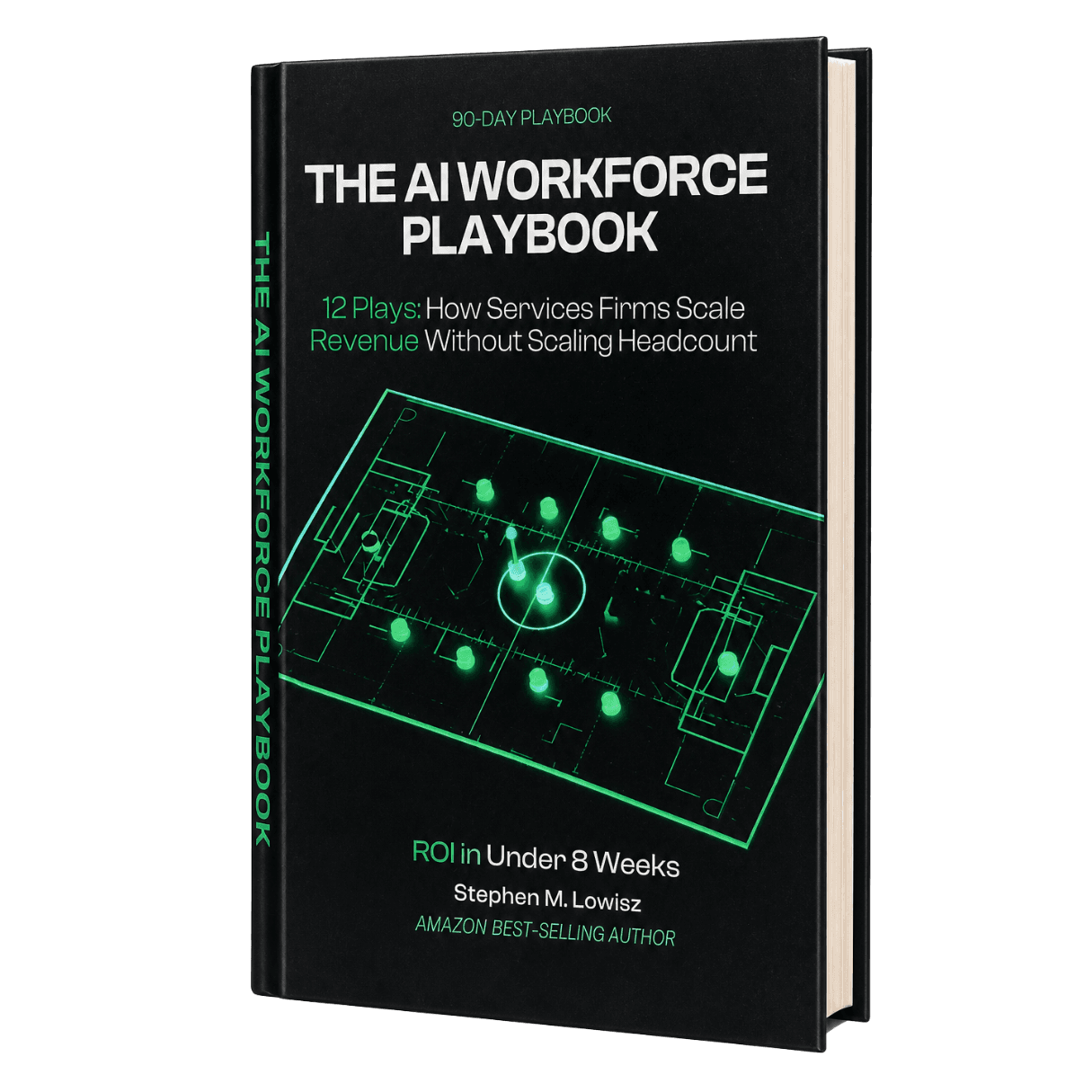
Amazon Best SellerThe AI Workforce Playbook
This piece is one chapter's worth. The book is the whole method - how professional-services firms grow on systems instead of headcount.
By Stephen Lowisz, Founder & CEO, Revenue Institute
Continue Reading
Want this implemented in your firm?
We build and run the technology your business grows on - for professional services and contract manufacturing firms of 50-500 people. A working system in your business inside the first 100 days.
Book a Strategy CallNot ready to talk? Start the free AI Opportunity Assessment.