AI-Enhanced CRM and ERP Integration
Why CRM and ERP systems drift apart, what a real AI-driven integration layer does, and how three client engagements killed manual re-keying without a bigger ops team.
Somewhere in your business right now, a person is re-typing a number that already exists in another system. A signed contract value keyed from the CRM into the finance system. A billing term copied out of an email into the ERP. A project scope moved by hand from the tool that sold the work to the tool that delivers it. It feels like a small tax. It is not. It is a standing headcount line disguised as 'that's just how we do it,' and it is usually the real reason your forecast and your finance team disagree.
Why the two systems drift apart
Most mid-market firms run a CRM - Salesforce or HubSpot - and a separate finance or ERP system - NetSuite, Sage, QuickBooks. They were never designed to share data. So the seam between them gets filled by people: someone re-keys the deal, someone reconciles the mismatch, someone chases the invoice that should have gone out on milestone completion. The downstream cost is not the typing. It is stale forecasts, invoices that slip past terms, and a finance team that has quietly stopped trusting the pipeline and started rebuilding it in a spreadsheet.
The usual fix is to buy more license - pay Salesforce or the ERP vendor for the connector, the extra objects, the seats - or to throw an operations coordinator at the seam. Both scale the cost without touching the cause.
And this is where the hype machine shows up, because 'integration' is a word every AI vendor now uses and almost none of them mean. A dashboard that reads from both systems is not an integration. A nightly export that overwrites yesterday's file is not an integration. If a vendor cannot tell you exactly which system wins when two records disagree, they have not built you an integration. They have built you a new place for the mess to hide.
What a real integration layer actually does
A working AI-driven integration is bidirectional and event-driven instead of batch-and-hope. When a contract is signed, an agent parses it, extracts the terms, writes them to the right fields in both systems, and flags a conflict the moment two sources disagree instead of silently picking one. The same layer keeps contact and account records synced, generates the invoice when the milestone closes, and surfaces a slipping receivable before it becomes a quarter-end fire. Three engagements show the range.
Merging two systems into one. A private-equity firm acquired two companies - one of 150 people, one of 300 - and needed them on a single revenue system inside 90 days, while also moving from QuickBooks to NetSuite at the same time. Revenue Institute merged the two Salesforce instances and the finance systems behind them, built the custom logic to keep them in step, and delivered in 88 days. The result: 42 percent saved on licensing by building the customizations instead of renting them, 23 percent off client-acquisition cost once the two teams could cross-sell from one source of truth, and an estimated 142 minutes back per rep per day that had been going to data entry.
Twelve systems into one. Rex, a property-technology holding company, ran eleven portfolio companies across five different CRMs plus spreadsheets, with more than 1.5 million records that were simply wrong - bad object types, data in the wrong fields, years out of date. Revenue Institute built one Salesforce instance segmented by permissions and record type, integrated each portfolio company's platform into it, and used software to identify and correct every record one at a time, then locked in validation rules so the mess could not come back. Estimated savings: $852K a year.
Making one system the source of truth. LawTrades, a legal-recruitment platform, was running a CRM that did not talk to its software database, a webinar tool that did not talk to marketing, and invoicing done by hand off work logs. Revenue Institute made HubSpot the single source of truth and built a real two-way sync between it and the LawTrades application, which eliminated the manual data entry entirely and gave every team one set of numbers to operate from.
Notice what those three engagements have in common. None of them is a story about a smarter model. Each one is a story about deciding which system owns which fact, then building the plumbing and the guardrails to keep that decision true when the volume comes. That is the unglamorous center of integration work, and it is exactly the part the hype machine skips, because it cannot be sold as a demo.
What it looks like when it works
The day-to-day tell is quiet, not dramatic. Nobody re-keys a contract, because the system that closed the deal already wrote the terms into the system that bills it. Finance stops rebuilding the pipeline in a spreadsheet, because the pipeline they are reading is the one sales is working. An invoice goes out the day the milestone closes instead of the week someone remembers. And when two systems disagree, a person gets a flag instead of a silent overwrite, so the error surfaces while it is still one record instead of a thousand. The measurable version of that quiet is the private-equity firm's 142 minutes a day per rep, no longer spent moving data between screens.
Where integrations go wrong
The first failure is automating on dirty data. A two-way sync on bad records does not clean them. It copies them, faster, into more places. Every one of the engagements above started by fixing data quality, and the one number worth memorizing - from Karbon's build, 37 percent of quotes carried pricing errors before anyone automated anything - is why. Automate the error and you own it twice.
The second is starting too big. The firms that succeed pick one workflow with high volume and clear rules - contact-and-account sync, invoice-on-milestone, order-status updates - and stand it up end to end before touching the next one. The ones that try to integrate everything at once end up with a project that is 80 percent done for a year.
The third is buying a connector and calling it a strategy. A tool that moves fields between systems does nothing about the reason the fields were wrong in the first place. If the vendor is not asking about your process before they quote the integration, that part is hype, and you should keep your check.
What this means for a 50 to 500-person firm
The re-keying tax is invisible until you price it. Take the loaded cost of a process hire - $85K to $120K a year is a fair planning assumption - and count how many people-hours a week your seam between CRM and finance actually consumes. That is the number the integration is competing with, and it is usually larger than the license. Tomi Bryan, a solo consultant, was quoted approximately $2M by vendors to build her platform; Revenue Institute built it on the Salesforce ecosystem for under $400K and automated 84 percent of her operations. The lesson is not the discount. It is that the honest number is almost always smaller than the one the reflex - hire someone, or rent the enterprise feature - quotes you.
If you want a plain read on where your systems are leaking hours, the free AI Opportunity Assessment takes about a minute and names the workflows worth integrating first. If you would rather walk your stack with someone who has merged systems under a real deadline, book a strategy call. And if your data is a mess, we will tell you that before we quote anything.
Operators and teams we've worked with



























Go deeper
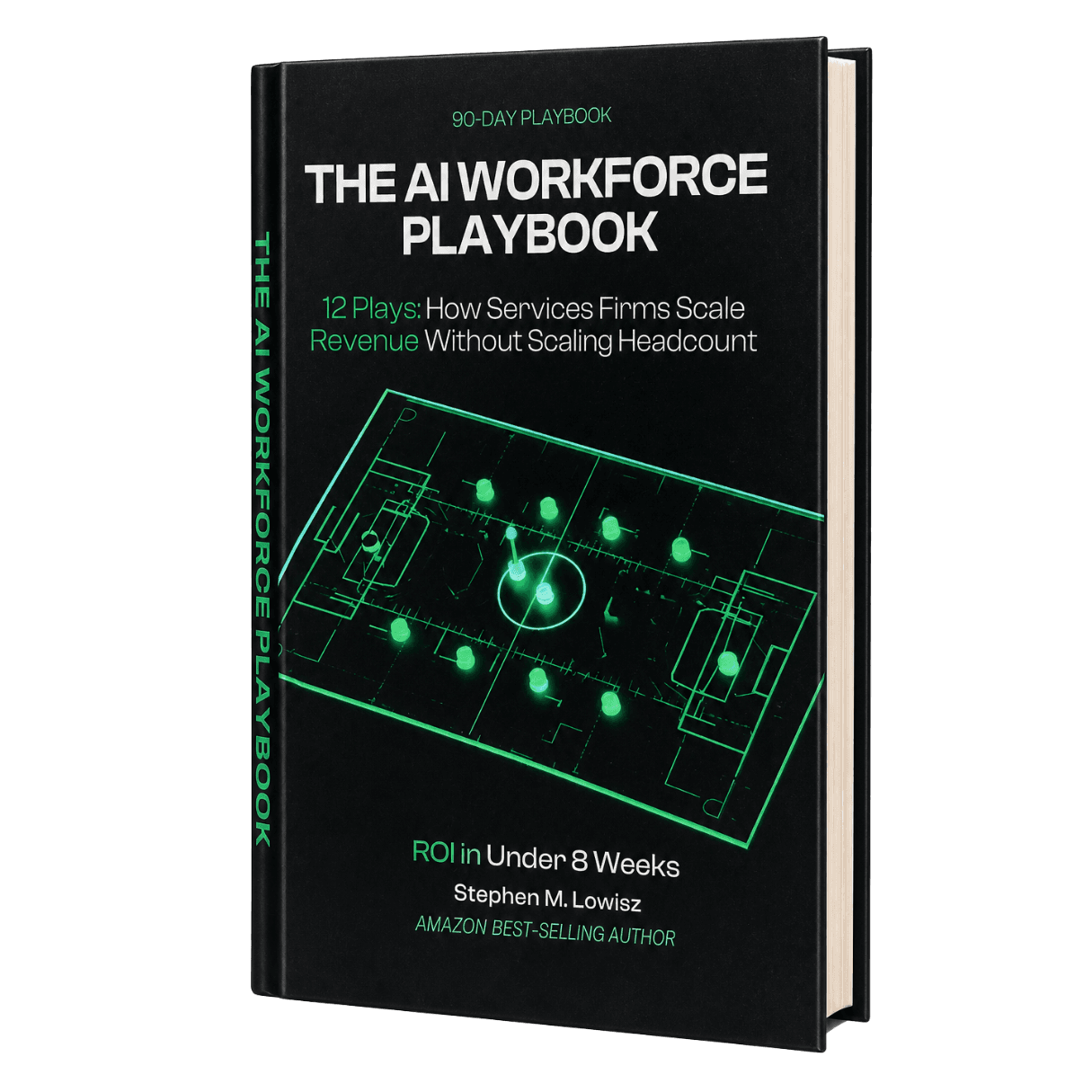
Amazon Best SellerThe AI Workforce Playbook
This piece is one chapter's worth. The book is the whole method - how professional-services firms grow on systems instead of headcount.
By Stephen Lowisz, Founder & CEO, Revenue Institute
Continue Reading
Want this implemented in your firm?
We build and run the technology your business grows on - for professional services and contract manufacturing firms of 50-500 people. A working system in your business inside the first 100 days.
Book a Strategy CallNot ready to talk? Start the free AI Opportunity Assessment.