AI Agents and B2B Operational Scalability
The headcount math on AI agents in B2B ops: what scales without people, proof from three named engagements, and how to automate one workflow safely.
By Stephen Lowisz · Revenue Institute
Amazon Best SellerAuthor of The AI Workforce PlaybookThe problem, stated in your unit of account
- When work piles up, the reflex is a job req, because hiring is the only lever most operators have always had. But ten process hires runs roughly $850K to $1.2M a year in loaded payroll (assume $85K to $120K per hire), it grows 3 to 5 percent annually, and each new person needs three to six months to reach full productivity - if they stay.
- Operational scalability is the question of how far revenue can grow before headcount has to grow with it. For most professional services and contract manufacturing firms that ratio is fixed by habit, not by necessity: every new tranche of volume gets a new coordinator, a new admin, a new analyst.
- An AI agent changes the ratio. It is a scoped piece of software that owns one repeatable workflow end to end, which means the next increment of volume no longer automatically requires the next increment of payroll.
What actually scales without people, and what does not
- The workflows that scale on agents are high-volume and rule-knowable: lead intake and qualification, CRM updates after every interaction, recurring client reporting, quote configuration, order-status updates, and deal-risk monitoring. The same shape of task, hundreds of times a week.
- The work that should never leave your people is the judgment work: the nuanced negotiation, the relationship call, the exception that is different every time. A firm that tries to automate judgment buys a demo. A firm that automates the process around the judgment buys capacity.
- The honest test before automating anything: if you cannot write down the rule, an agent cannot run it. That is not a limitation to hide - it is the line that tells you which half of the work is safe to hand over.
Proof from named engagements
- Karbon, a 350-person accounting-software company, had 34 sales reps each losing more than four hours a week to configuring and pricing quotes by hand, with 37 percent of outgoing quotes carrying errors. A custom-built quoting system returned 136 hours a week - roughly three and a half full-time hires' worth of work - and took quote accuracy to 100 percent, for a one-time build under $25K against a $250K-a-year software quote.
- helloCash, a point-of-sale software company in German-speaking Europe, ran a high-volume, low-margin model where a sales rep per account was never going to pencil out. Three agents - one tracking where users stalled, one timing the follow-up, one handling onboarding paperwork - moved free-to-paid conversion from 7 percent to 62 percent without adding sales headcount.
- Tomi Bryan, a solo consultant, automated 84 percent of her operations on a custom-built platform and grew revenue 32 percent in 90 days - scale that would otherwise have required hiring an operations staff she did not want.
The two reflexes worth pointing your skepticism at
- The first is the AI hype machine: the agencies that rebranded last year, the consultants selling slides, the chatbot bolted onto a login screen. Your instinct to delete those emails is correct, and a real agent has nothing in common with them.
- The second is quieter and more expensive: the default hiring reflex, throwing payroll at a process problem because it is the lever you have always had. It feels responsible. It is the single largest recurring cost most operators never question.
- The move is not to trust AI. It is to stop trusting either reflex on faith, and to demand from every vendor the one thing the hype machine cannot produce: a named client and a real number.
The math that decides which workflow goes first
- Rank your open capacity gaps by volume, not by which one is closest to the CEO's inbox. The workflow with the most repeats per week - not the most visible one - is the one where a system pays back fastest.
- Price the req you would otherwise post against the build: an $85K-$120K hire with three to six months of ramp versus a scoped agent build with a fixed quote. That comparison, run honestly, is usually what makes the decision for you.
- Every engagement in the proof section above started with a data-quality pass before anything was automated - a system that writes to broken records just breaks them faster and at higher volume.
- Put the handoff rule in writing before the contract is signed: which decisions the system makes alone, which ones route to a person. That is what lets your COO sign off and your team trust it on day one.
The headcount math for a 50 to 500-person firm
- The choice at your size was never agents versus people. It was always systems that compound versus a hiring plan that resets every year. Stop buying hours: your current team stays, the process work moves to systems, and the judgment work stays with your people.
- The cost of doing nothing does not appear on the P&L as a line item. It appears as a competitor running the same work on systems, quoting faster and cheaper, while your headcount-to-revenue ratio holds you in place.
- If you want to see which of your workflows would survive the audit, the free AI Opportunity Assessment maps it in about a minute. If you would rather talk it through with an operator who has built these, book a strategy call - and if an agent is the wrong tool for your problem, we will say so.
- This is the short brief version of that math. Our companion long-form piece, 'How AI Agents Are Reshaping B2B Operations,' goes deeper on the architecture and governance side - what an agent actually is, the handoff-rule mechanics, and the Kitcast engagement in full.
Operators and teams we've worked with


























Go deeper
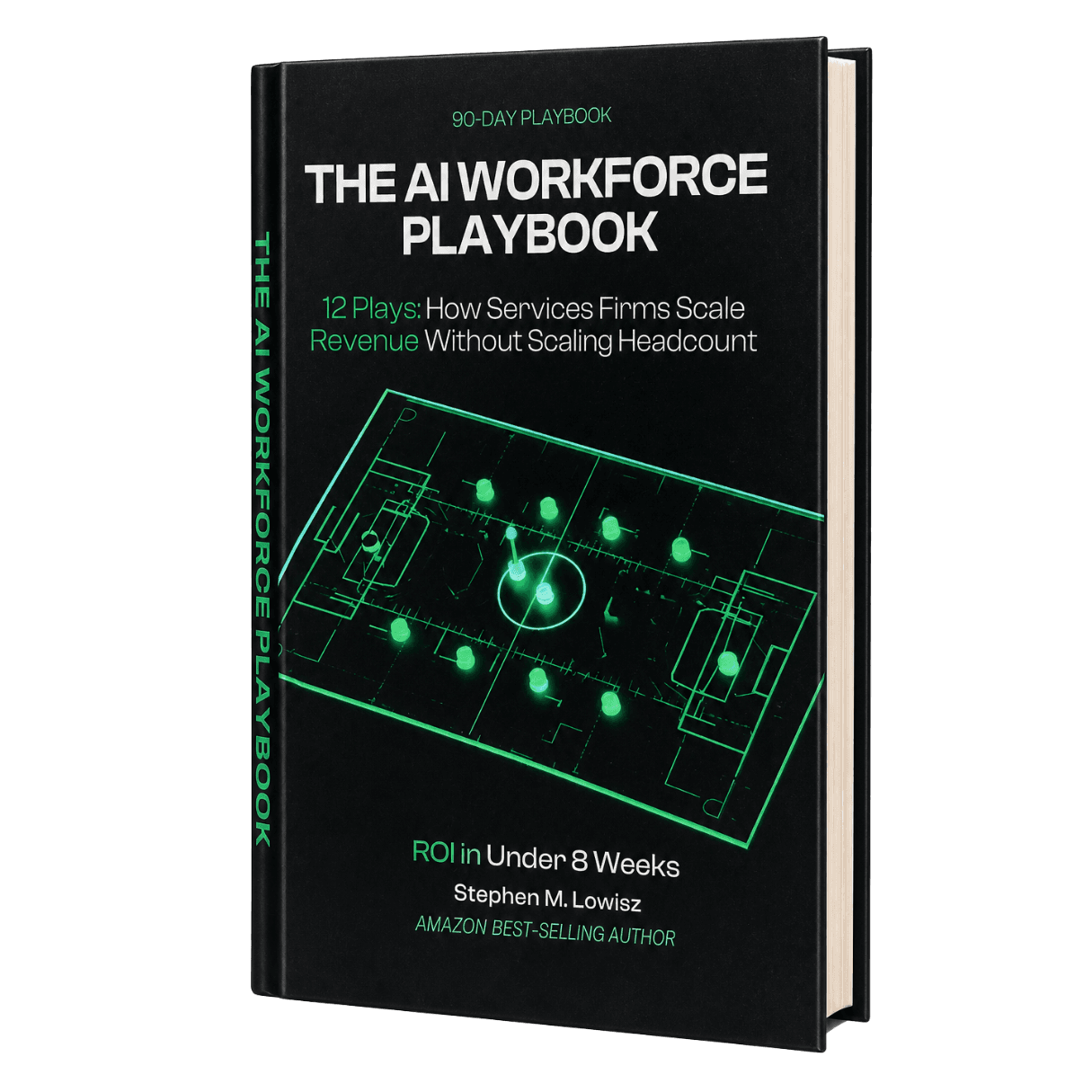
Amazon Best SellerThe AI Workforce Playbook
This piece is one chapter's worth. The book is the whole method - how professional-services firms grow on systems instead of headcount.
By Stephen Lowisz, Founder & CEO, Revenue Institute
Continue Reading
Want this implemented in your firm?
We build and run the technology your business grows on - for professional services and contract manufacturing firms of 50-500 people. A working system in your business inside the first 100 days.
Book a Strategy CallNot ready to talk? Start the free AI Opportunity Assessment.