How AI Agents Are Reshaping B2B Operations
What an AI agent actually is inside a B2B operation, the workflows worth automating first, and how three named firms cut process work without adding headcount.
Your operations team is capable. It is also underwater. So the next move is the one every operator has always had: post the req, run the loop, absorb three to six months of ramp, and hope the hire stays. Ten process hires runs $850K to $1.2M a year in loaded payroll, every year, growing 3 to 5 percent, at a loaded cost of $85K to $120K per hire (a planning assumption you can check against your own P&L). An AI agent is the first tool that does the process work those hires would do, without the hires. The word that matters in that sentence is process, not people.
Before we go further, a concession you have earned. Most of what lands in your inbox with 'AI' in the subject line is noise: agencies that rebranded eight months ago, consultants selling slides, a chatbot bolted onto a login screen. If you have stopped opening those emails, you were right to. An AI agent is not that. It is worth being precise about what one actually is, because the category has been so thoroughly abused that the word has almost stopped meaning anything.
What an AI agent actually is
Strip the marketing off and an agent is a scoped piece of software that owns one defined workflow inside the systems you already run. It reads unstructured inputs - an inbound email, a signed contract, a call transcript - decides what to do against your data and your rules, takes multi-step action across your CRM, your finance system, and your ticketing tool, and hands the decision to a person the moment it exceeds what it was allowed to do. That last part is the whole game. An agent without an explicit handoff rule and an audit trail is a liability. An agent with them is a worker that never forgets a step and never has a bad Monday.
The difference from the older automation you have probably been burned by is that rule-based scripts break the first time an input does not match the template. An agent reads the intent, not just the fields, so a slightly different contract or an email that buries the ask in paragraph three does not stop the line. That is why it can own a whole workflow instead of one brittle step inside it.
Where the day-to-day actually changes
The value shows up in three measurable places: how fast inbound work gets handled, how clean your data stays, and how much routine volume a small team can absorb before it has to hire. Two named engagements make the shape concrete.
helloCash, a point-of-sale software company serving German-speaking Europe, was converting 7 percent of its inbound leads to paid plans. Its model was high volume and low margin, so a sales rep on every account was never going to pencil out. Revenue Institute deployed three agents against that one problem: one that followed each user through the product to find where they stalled, one that timed the follow-up messaging to each user's behavior, and one that handled the onboarding paperwork. Conversion moved from 7 percent to 62 percent. The revenue number attached to that result is unusual, and it is helloCash's own measurement against the baseline they would have closed, not our independent verification, so we mention it only with that caveat: the point that travels is the mechanism, not the headline.
Kitcast, a fifteen-person digital-signage company with no network in the United States, needed enterprise pipeline and could not afford a Silicon Valley sales team to build it. AI agents identified in-market accounts, reached the senior decision-makers sitting behind the gatekeepers, and booked qualified enterprise meetings inside 120 days, against a normal enterprise cycle of 180 to 360. Fifteen people produced the output a much larger outbound team would have been hired to produce.
How to stand one up without getting burned
The firms that get value from agents and the firms that buy an expensive demo do the same first steps in a different order. Here is the order that works.
Start with the workflow you were about to hire for. Not the most interesting workflow, the most repeated one. If the same shape of task runs hundreds of times a week and the rules are knowable, it is a candidate. Lead intake, CRM updates after every interaction, recurring client reporting, and quote configuration are the usual first builds because they are high volume and low judgment.
Audit the data before you automate anything. An agent writing to dirty records scales the mess faster than a human ever could. Karbon, a 350-person accounting-software company, found in a pre-build audit that 37 percent of its outgoing quotes contained pricing errors. Fixing the process the software would run, before running it, is the reason that project worked and took quote accuracy to 100 percent.
Write the handoff rule first. Decide, on paper, exactly which decisions the agent makes alone and which it escalates to a person. This is what keeps your team in the judgment seat and the agent in the process seat, and it is the line the COO will want to see before the ops team will trust the thing.
Ship one workflow end to end before you expand. A working agent in production teaches you more in a week than a six-month planning deck. Prove it on one process, in your business, then widen.
Where these go wrong
Agents fail when they are scoped as 'automate the department' instead of 'own this one workflow.' They fail on dirty data. They fail when nobody on your team owns the outcome, so there is no one to notice the agent quietly drifting. And they fail when the handoff rule is vague, because the agent then either escalates everything, which is useless, or nothing, which is dangerous. None of these are model problems. They are scoping and ownership problems, which means they are fixable before you spend a dollar.
One more honest line. If the work you want handled genuinely requires human judgment on most cases - a nuanced negotiation, a relationship call, an exception that is different every time - an agent is the wrong tool, and a good partner will tell you so instead of selling you one anyway.
What this means for a 50 to 500-person firm
At your size, the choice is not agents versus people. It is systems versus the next ten reqs. The reflex to staff every gap with headcount is the most expensive habit in professional services and contract manufacturing, and it will not show up as a line item until a competitor running the same work on systems is quoting faster and cheaper than you. So point your skepticism at the right target. Not at whether AI is real, because your competitors have already answered that, but at every vendor who cannot show you a named client and a real number. Keep your people. Hand the process work to systems. Let the judgment work stay where it belongs.
If you want to see which of your workflows would survive that audit, the AI Opportunity Assessment is free and takes about a minute. It maps where an agent would pay for itself and, just as usefully, where it would not. If you would rather talk it through with someone who has built these, book a strategy call and we will start with the work you were about to hire for, not a demo.
Operators and teams we've worked with



























Go deeper
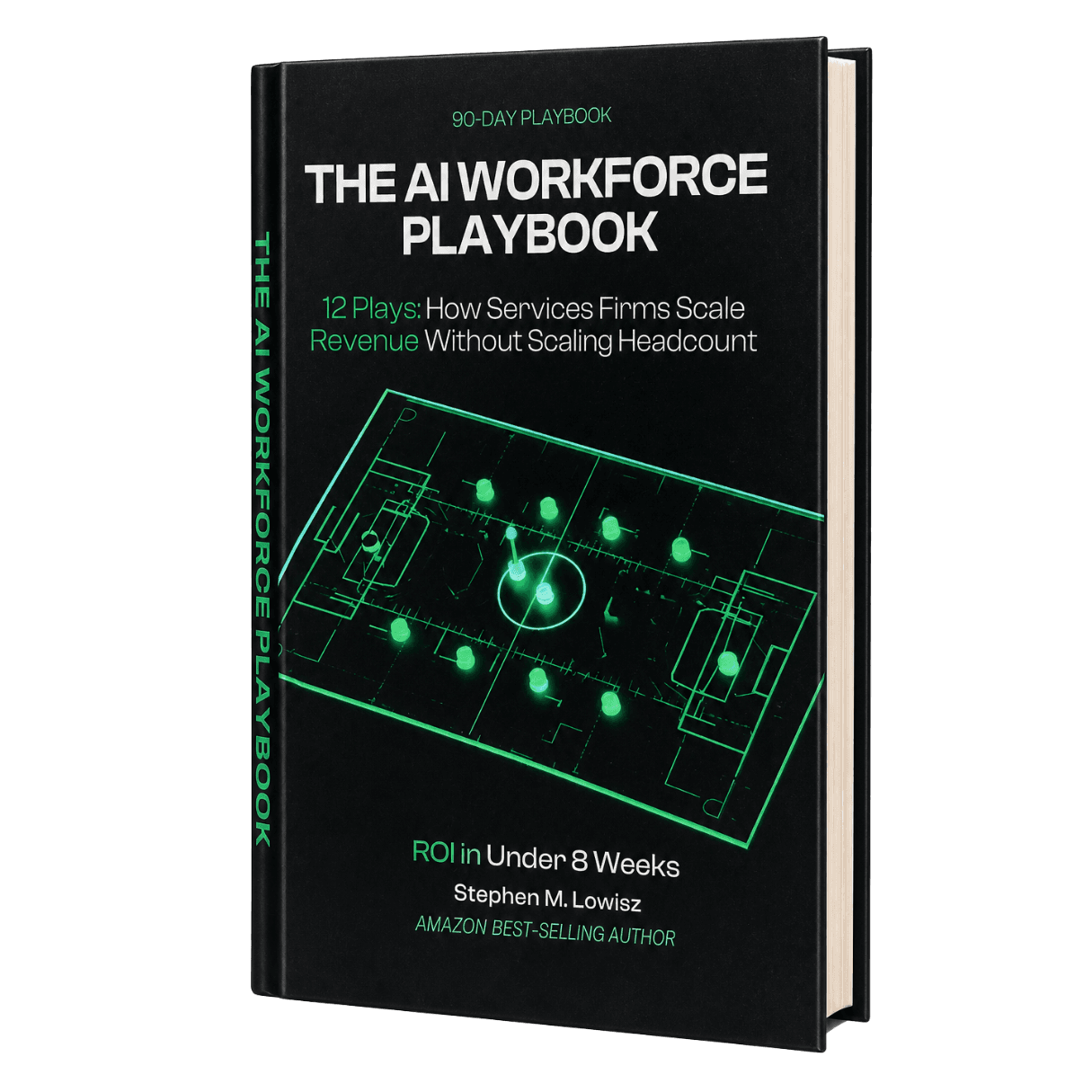
Amazon Best SellerThe AI Workforce Playbook
This piece is one chapter's worth. The book is the whole method - how professional-services firms grow on systems instead of headcount.
By Stephen Lowisz, Founder & CEO, Revenue Institute
Continue Reading
Want this implemented in your firm?
We build and run the technology your business grows on - for professional services and contract manufacturing firms of 50-500 people. A working system in your business inside the first 100 days.
Book a Strategy CallNot ready to talk? Start the free AI Opportunity Assessment.